Impact strength
The flexible segments between carbonyl and ethylene units dissipate energy under impact. Notched impact is 230% higher than Nylon and PBT.
IMPACT +230%
POKETONE is the aliphatic polyketone Hyosung commercialised first in the world. Understand the molecular structure and you understand why it leads on hydrolysis resistance, wear and barrier at the same time.
POKETONE is a highly crystalline aliphatic polyketone — Polyketone, POK — made by alternating copolymerisation of carbon monoxide (CO) and olefins. Every other carbon in the backbone carries a carbonyl group (C=O). That regular carbonyl sequence lets the chains pack tightly into a highly crystalline structure, and that is where the strength, wear resistance and barrier come from.
Two families exist, depending on the comonomer. The binary alternating copolymer of CO and ethylene goes mainly into high-strength fibre. Add propylene and you get the terpolymer — slightly lower melting point, wider processing window, and the form that dominates engineering-grade POK.
From a feedstock point of view, POK consumes carbon monoxide — an industrial emission — turning an air pollutant into a polymer. That is why it is often called a green engineering plastic.
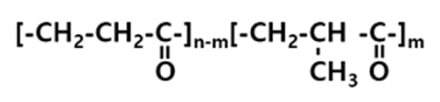
Hyosung’s published POK repeat unit — carbonyls strictly alternating, n ethylene units and m propylene units.
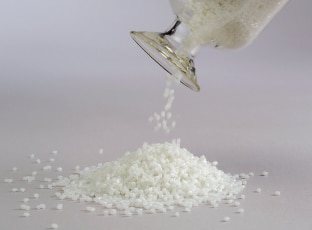
Natural pellets are near ivory — light-coloured parts can run without masterbatch.
Every property traces back to a structural feature — this is not marketing copy. Understand the mechanism and you can judge at drawing-board stage whether POK fits.
The flexible segments between carbonyl and ethylene units dissipate energy under impact. Notched impact is 230% higher than Nylon and PBT.
A carbon–carbon backbone with no hydrolysable ester or amide links, so molecular weight holds up under prolonged immersion or high humidity. Certified to KTW and W270.
High crystallinity blocks solvent and chemical ingress. Outstanding acid and alkali resistance — second only to PPS.
Dense crystalline structure and low friction. Standard grades wear three times better than POM; modified grades reach 10× or more.
Polar carbonyl groups pack the chains tightly and resist hydrocarbon permeation. In petrol at 93°C over 15 days it beats PTFE and matches EVOH.
Carbon monoxide as comonomer, no harmful plasticisers or formaldehyde, recyclable — suitable for food contact and children’s products.
POK is not positioned as a cheaper PA66. It refuses to compromise on hydrolysis resistance, wear and barrier at the same time — and when a duty demands all three, it is often the only answer.
| Property | POK | PA66 | POM | PBT |
|---|---|---|---|---|
| Hydrolysis | ●●●●● | ●●○○○ | ●●●○○ | ●●●○○ |
| Chemical media | ●●●●● | ●●●○○ | ●●●○○ | ●●●○○ |
| Wear / self-lubrication | ●●●●● | ●●●○○ | ●●●●○ | ●●○○○ |
| Gas barrier | ●●●●● | ●●●○○ | ●●○○○ | ●●●○○ |
| Fuel resistance | ●●●●● | ●●●○○ | ●●○○○ | ●●●○○ |
| Impact strength | ●●●●● | ●●●○○ | ●●○○○ | ●●○○○ |
| Dimensional stability | ●●●●○ | ●●●○○ | ●●●●○ | ●●●●○ |
| Processing window | ●●●○○ | ●●●●○ | ●●●●○ | ●●●●● |
* Qualitative comparison compiled from Hyosung POKETONE literature. On processing window, POK demands tighter drying and mould-temperature control — see Technical Support.
These figures come from Hyosung published data. They are not peak values but what standard grades hold consistently — which matters more in selection than a headline number.
Around 220°C — roughly 40°C below PA66, which pays off in energy and cycle time
Sustained high-temperature service, covering most under-hood and electronic duties
Improvement over Nylon and PBT, holding in notched and low-temperature conditions
Multiple versus POM: about 3× for standard grades, up to 14× when modified
Barrier level against moisture and hydrocarbons, close to dedicated barrier resins
An all-carbon backbone with no ester or amide links — the root of its hydrolysis resistance
Hyosung divides POKETONE by melt index and melting point into six main series and three special ones. The first selection question is not strength — it is which flow and melting band you need.
| Series | Flow & melting | Typical position | Grades in stock |
|---|---|---|---|
| M130 | Very high flow | Thin walls, long flow paths, small precision parts; structures sensitive to injection pressure; food contact applications | M130F |
| M330 | High flow | General injection mouldings, thin-wall housings, multi-cavity tools | M330AM330A-UVM330FM330F-SM330S |
| M530 | Medium flow | Medium and thick-wall parts, fittings — balanced between M330 flow and M630 impact | M530F |
| M630 | Medium flow · high impact | The most balanced series — impact and stiffness together, and our highest-volume family | M630AM630FM630V |
| M730 | Low flow | Thick sections and where high melt strength matters; better creep resistance | M730RM730F |
| M710 | Low flow · low melting | Parts sensitive to thermal history — run cooler to cut degradation risk | M710F |
| M410 | Monofilament · low melting | Monofilament, fibre and continuous forming that needs high draw orientation; the low-bloom version suits food contact | M410F-S |
| M640 | Low-temp impact · high melting | Cold climates and low-temperature impact, with heat resistance kept | M640A |
| E700 | PK compound for EVOH blends | Blended with EVOH to improve retort performance and barrier — packaging and pipe | On request |
* Series classification per Hyosung. The stock column reflects our current grade list; colour variants of the same grade (natural, black, white, grey and so on) are not listed separately. Flow and suitable processes follow the individual TDS, available on request.
This is where new projects get caught. The five points below are what we see most often on the floor; for production parameters, follow the grade TDS and your own mould trials.
| Stage | What to do | What goes wrong |
|---|---|---|
| Drying | Hot-air dry at 80–100°C for 3–4 hours; a dew point below −20°C is better still | Under-drying gives silver streaks, bubbles and lower impact strength |
| Melt temperature | Typically 220–260°C depending on grade; avoid long residence time | Overheating or dwell causes degradation — yellowing and odour |
| Mould temperature | 60–90°C recommended; a hotter mould completes crystallisation | A cold mould raises shrinkage and destabilises dimensions |
| Screw | Medium speed, medium pressure and back pressure; avoid high shear | High shear causes melt fracture and local overheating |
| Regrind | Usable in moderation, with the ratio controlled and the regrind re-dried | Too much regrind accumulates degradation and hurts long-term properties |
Most POK applications sit in food contact, drinking water or children’s products — where the compliance file matters more than the data sheet. Native grades hold the certifications below, and we supply the matching batch documents with the goods.
Food Contact Notification covering repeated-use articles
Including the (EU) 2020/1245 amendment for plastic food contact materials
Meets Chinese requirements for food contact materials and articles
Sanitation standard for materials in commercial food equipment
Health effects of drinking water system components
Hygienic assessment of plastics in contact with drinking water
Material approved under the UK water regulations scheme
French sanitary compliance for drinking water contact materials
Safety evaluation for equipment and protective materials in drinking water supply
Dimensions and quality requirements for pipes and fittings
Biological evaluation of materials for medical devices
The ISO series for biological evaluation of medical devices
Upstream production and quality management system certification
Free of harmful plasticisers, bisphenol A, phthalates and heavy metals
Base certifications for native grades are issued by Hyosung. Whether the finished article can claim compliance also depends on masterbatch, additives and processing. We supply the original COA, compliance declarations and migration testing support to help you file.
* Applicability depends on grade and end use. Ask us for the relevant certificate copy — the document governs.
Temperature, media, load type, moulding process — four inputs, and we come back with a defensible grade recommendation plus the matching TDS.
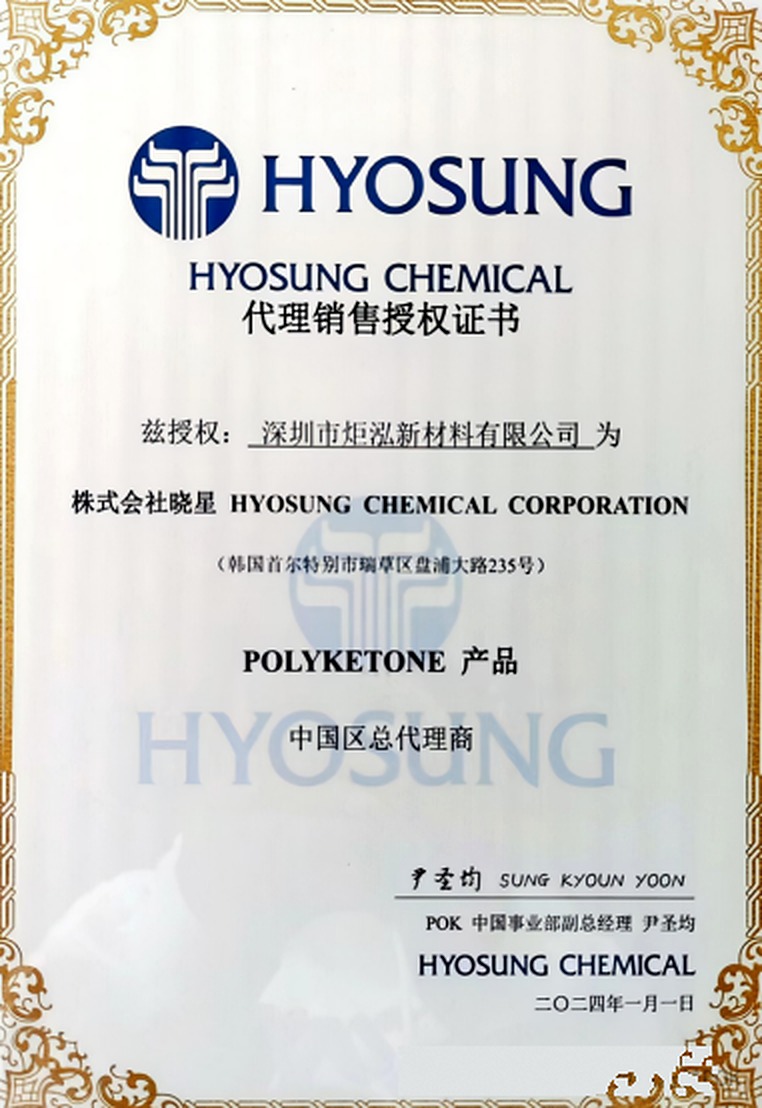
HYOSUNG CHEMICAL · Distributor Authorization Certificate · 1 January 2024