Technical Support & Contact
POK has a narrower processing window than PA or POM — drying, mould temperature and screw configuration all affect the result. We turn that experience into checklists you can act on, ship the original technical documents with the goods, and stay reachable when you need a person.
From grade selection to volume production, in four steps
These are not decorative steps — each has a defined deliverable and a pass criterion. If a step fails we recommend a different grade or a different material rather than pushing ahead.
Duty assessment
In: temperature range, contact media, load type, expected life, moulding process. Out: two or three candidate grades plus the risks to watch.
Sampling & trials
Kilogram-scale samples and a recommended process window, with support on runner, venting and cooling. Trial parameters are recorded.
Process tuning
Drying curve, melt and mould temperature, injection speed, hold pressure and cycle locked down, delivered as a reproducible parameter sheet.
Volume assurance
Batch consistency tracking, COA with every shipment, regional stock, and a fallback grade if supply is interrupted.
Downloads
Original TDS, processing parameters and application reports. The library is updated continuously — if you need a grade that is not listed, ask the technical team directly.
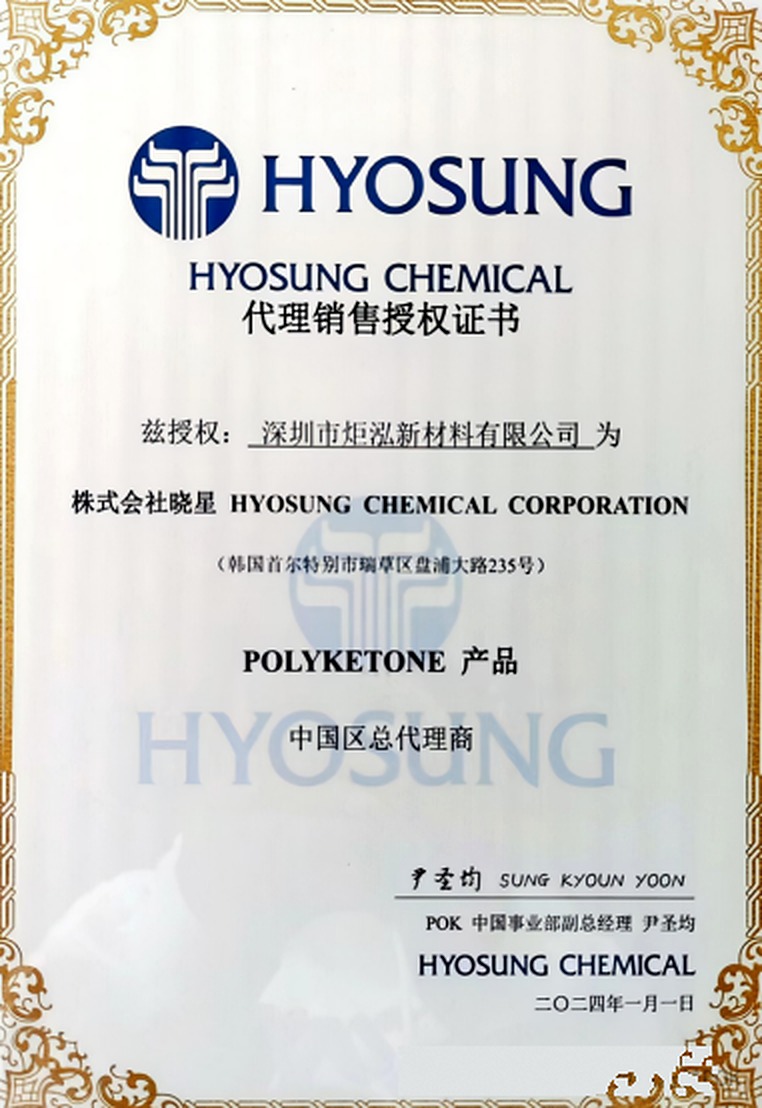
Hyosung certificate of authorization (copy)
Licensor, licensee, products, territory, signatory and datePOKETONE compliance certificate list
Fourteen entries including FDA, EU 10/2011, NSF, KTW, WRAS, ACS and GBPOKETONE processing guide
Injection temperatures, drying, mould temperature, screw setup and a defect troubleshooting tablePOKETONE properties and applications
Test methods behind the six properties, with typical case studiesPOKETONE in connectors
Grade selection, flame retardancy and electrical validation for connectorsPOKETONE thermal data report
DSC, HDT, Vicat and TGA dataAutomotive connector damp-heat report
Property retention at 85°C / 85% RHJuhong modified POK grade list
All 67 modified grades: system, characteristics and recommended usePOK sheet and rod specification
Stock thicknesses, diameters and custom ranges* Documents are sent after a short registration so we can control version validity. Click any title to request it by email, or simply call.
Common questions on selection and processing
Question not covered? Ask the technical team — usually answered the same day.
Email the technical team